The issues our clients face can be further complicated when they lack digital and online access. This is known as digital poverty and one of our aims is raising awareness about the effect it has on people.
Anyone can experience digital poverty if they lack finance, skills or connectivity. Those who lack access to the internet tend to include those who are unemployed, are older, have a disability, have lower educational attainments, or live in social housing or deprived areas.
Those who experience digital poverty are often disadvantaged in the following ways:
- Salary increases. Jobs that entail digital skills offer a three to ten per cent higher than those that don’t.
- Employment opportunities. Without digital access, people have a reduced likelihood of finding employment.
- Online discounts. Shopping on the high street is on average 13% more expensive than shopping online.
- Community. Digital disengagement often means less communication with family, friends, and others.
- Time. It takes on average 30 minutes longer to complete transactions with banks and other essential services in-person than it does online.
Digital transformation programmes can be a problem
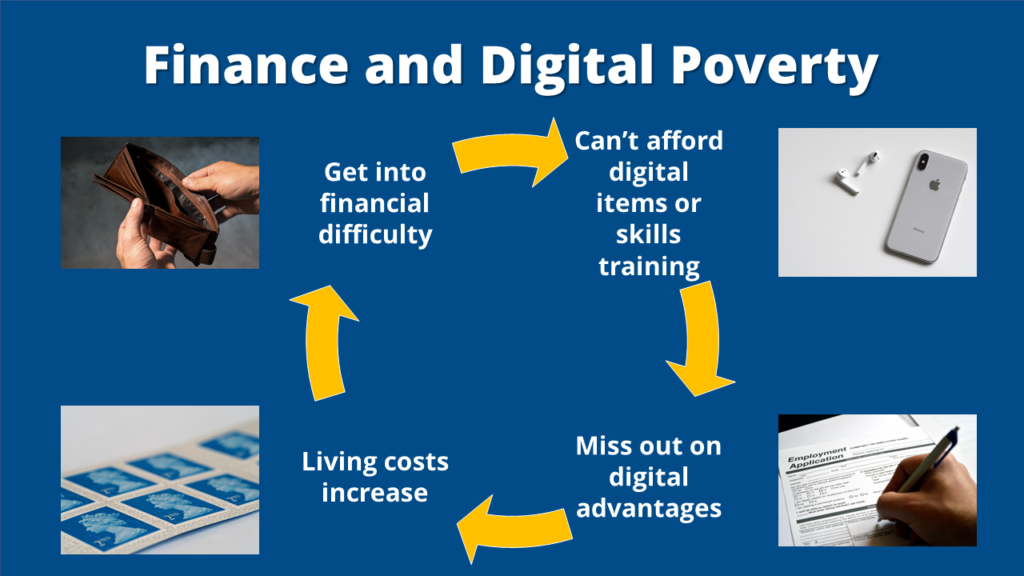
Businesses and organisations that encourage their customers to use their services digitally may accelerate the spiral of digital poverty and leave people even further behind.
When someone’s only option is to engage online, they need the right device or connection to access the internet, which means that may of the costs of providing a service shifts from the business (for example, staffing costs) to the customer.
Some digital transformation programmes might be viewed as digital offsetting, rather than increasing efficiency.
We work with organisations undertaking digital transformation programmes to:
- Carry out risk assessments that consider the wider impact
- Design digital transformation programmes to include in-person support, so that those experiencing digital poverty aren’t excluded from getting help
- Ensure that those experiencing digital poverty aren’t penalised for not being able to access digital services
What are basic digital skills?
In 2015, the CEBR identified 5 key areas that signify basic digital skills.
- Managing information – Being able to use search engines and comparison sites and store data online.
- Communicating – Being able to use emails, social media and video calls.
- Transactions – Having the ability to manage a bank or Universal Credit account or to shop online.
- Problem-solving – Using online tutorials to self-train.
- Creating – Being able to develop content for social media or online communities.
Not having these skills or just lacking some of them can have serious consequences.
Example 4
A client with a disability came to us after getting into debt due to parking fines. She lacked the confidence and digital skills required to get a blue badge that would give her disabled parking access. This was also a problem when it came to challenging parking fines online.
She’d incurred these fines while driving a disabled friend to various destinations. With no money to pay the fines and no skills to challenge them online, the fines increased in size. Eventually, she was threatened with bailiffs coming to take away her possessions.
Our charity’s advisers are negotiating to see if we can stop the bailiffs from taking away her possessions.
Findings
- Digital offset – Digital transformations can push staffing costs onto other organisations and digital product costs onto citizens accessing online services.
- Digital isolation – The risk of vulnerable people being exposed to abuse may be increased by Digital Poverty. This is because isolation may lead to people taking advantage of them when they don’t have in-person support.
- Weak digital infrastructure – Digital innovations and transformations are outpacing people’s ability to access these digital services.
- Anyone can suffer from Digital Poverty. We can’t just focus on specific groups. We should consider aspects of everyone’s digital finance, skills and connectivity.
How do we address these concerns?
The government’s 2017 digital strategy suggests pushing for greater digital adoption. This is evident from plans to:
- Increase fibre broadband coverage
- Encourage digital training within businesses
- Help businesses access digital innovations.
However, our research shows that when digital solutions fail, people use other more expensive options. For example, using mobile data to home school children or seeking out support from other organisations like Citizens Advice. So how can we prevent this?
We suggest:
- Risk assessments – Conduct in-depth risk assessments before making digital transformations. These should consider wider impacts for individuals and other organisations, include varied aspects of Connectivity, Skills and Finance gaps. They should also recognise that anyone might suffer from Digital Poverty.
- In-person support – Design digital transformations with ‘in-person’ support to shrink the digital divide, helping people access online services. This may reduce the need for other organisations to access digital services on behalf of the digitally impoverished.
- Prevent offset – Ensure that people aren’t penalised when their digital poverty stops them from easily accessing digital services.